Now Available
Guns N’ Roses, Rock & Roll, and the Sounds of the Lyric Tradition
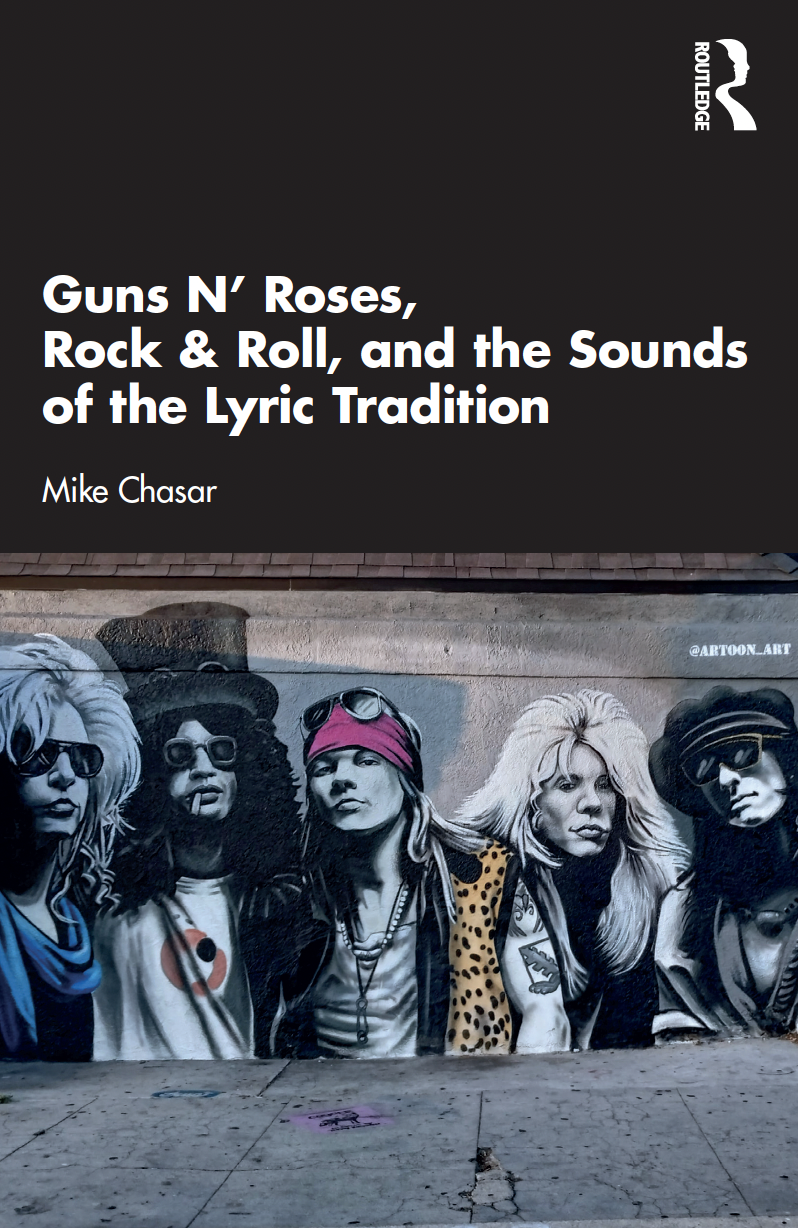
By Mike Chasar
Routledge, 2026
In this innovative book, Mike Chasar forwards a theory for how we read, hear, and understand popular music lyrics on their own, in relation to each other, and in relation to the poetic tradition that they inherit, revitalize, and push into new expressive quarters.
When Guns N’ Roses lead singer Axl Rose belts out the series of “ohs” in the chorus from one of the band’s most famous songs—“Whoa, oh, oh, oh, sweet child o’ mine”—exactly what sort of poetic work is going on? When Freddie Mercury sings “Mama, oooh, didn’t mean to make you cry” on Queen’s “Bohemian Rhapsody,” what does that “oooh” accomplish? We all know the pleasure of unpacking the content of the songs we love, and Guns N’ Roses, Rock & Roll, and the Sounds of the Lyric Tradition deepens that pleasure by exploring some of pop music’s most common yet possibly most obscure verbal pyrotechnics—sounds like “oh” and “oooh” that have no dictionary meaning but that nevertheless activate a broader set of poetic strategies and concerns that end up linking modern song lyrics to the lyric expressions of Shakespeare, Shelley, and Keats.
"Chasar's brilliantly conceived book, executed with streetwise style and infectious verve, applies lyric theory to the spectacularly unlikely limit case of Axl Rose's barbaric yowl. The howling vowels of Appetite for Destruction become, in Chasar’s hands, hidden keys to the album’s narrative crux and to the chart-busting appeal of its sensuous form, the way it engineers maximum feeling. Poetry and rock have rarely got along so well." Matthew Kilbane, University of Notre Dame
↓ More Below ↓
Now in Paperback
The Poetry of Bob Dylan: Thirty Essays on Thirty Songs

Edited by Mike Chasar
Bloomsbury Academic, 2025
“In The Poetry of Bob Dylan, editor Mike Chasar has gathered thirty virtuosic readings of individual Dylan songs by leading scholars in the fields of poetry and poetics, sound studies, and popular culture. In illuminating what the Nobel Prize committee calls Dylan’s ‘poetic expressions,’ these smart and engaging analytical essays move beyond the fantasy of poetry as a detached page-bound relic. Instead, they provide us with a guide to the multiple ways we listen to, store, playback—and play with—literary objects. Appropriate for both long-time researchers and readers new to these fields, this book is a key entry in the study of Bob Dylan’s work and a powerful introduction to the expanded literary field of the twentieth- and twenty-first centuries.” John Melillo, Associate Professor of English, University of Arizona
“The Poetry of Bob Dylan constitutes a much-needed literary reckoning with specific important works from across Dylan’s working life as a writer. These thirty brief essays, carefully composed by thirty different literary scholars concerning thirty distinct songs, speak not only to a new generation of Dylan students and listeners but also to the future—a future that will relate to these songs as the artistic creations of a great poet.” Robert Boschman, Professor of American Literature, Mount Royal University
↓ More Below ↓
Poetry Unbound: Poems and New Media from the Magic Lantern to Instagram

By Mike Chasar
Columbia University Press, 2020
In Poetry Unbound, Mike Chasar reveals the new horizons that poetry has found beyond books and off the page. Refuting the claim that poetry has become a marginal art form, he shows how it has played a vibrant and culturally significant role by adapting to and shaping new media technologies in complex, unexpected, and powerful ways. Beginning with the magic lantern and continuing through the dominance of the internet and social media, Chasar follows poetry’s travels into newer formats that include radio, film, and literature.
“By disclosing what are at once poetry’s most inscrutable and its most public aspects, Chasar reorients our understanding of poetry’s relation to the media, throwing gasoline on the fire of a question we have dodged for too long: what is a poem? The old answers to that query won’t hold up in the wake of Chasar’s attention to the vulgar afterlives of bookish things.” Daniel Tiffany, author of My Silver Planet: A Secret History of Poetry and Kitsch
“Poetry is more than a creature of voice, hand, and press, as Chasar shows with verve, wit, insight, and sparkling detail. The public life of poetry in the twentieth-century United States is also a secret history of multimedia. Each medium remakes poetry. And poetry, in turn, remakes the media in which we live, move, and breathe. I love this book!” John Durham Peters, author of The Marvelous Clouds: Toward a Philosophy of Elemental Media
↓ More Below ↓
Everyday Reading: Poetry and Popular Culture in Modern America

By Mike Chasar
Columbia University Press, 2012
Exploring poetry scrapbooks, old-time radio show recordings, advertising verse, corporate archives, and Hallmark greeting cards, among other unconventional sources, Mike Chasar casts American poetry as an everyday phenomenon consumed and created by a vast range of readers. He shows how American poetry in the first half of the twentieth century and its reception helped set the stage for the dynamics of popular culture and mass media today.
“Chasar shows us that if we can rethink our ideas about poets and poetry, we will find that poems have always been part and parcel of modern life. This is an important—really, a necessary—book for anyone interested in modern poetics, the history of reading, and the many appearances of poetry in the era of its supposed disappearance.” Virginia Jackson, University of California, Irvine
“An ambitious, serious claim on present-day literary studies, and a surprise and a delight, Mike Chasar combines the painstaking, arduous archival methods of real historians with the close analyses that we expect from literary critics, applied to verse, images, and informative prose ephemera. He persuasively links William Carlos Williams’s innovations to roadside signs and the Iowa Writers’ Workshop to the Hallmark card, and he may change how you see eminent writers’ work. More than that, Chasar gets twenty-first -century readers to notice the uses that so many Americans, only a couple of generations ago, found for the poetry they enjoyed. Or, to take up a mode Chasar appears to be the first to analyze: THIS OLD-TIME VERSE / HAS LOTS TO SAY / IF YOU CAN READ IT / CHASAR’S WAY.” Stephanie Burt, Harvard University
↓ More Below ↓
Poetry after Cultural Studies
Edited by Heidi R. Bean and Mike Chasar

University of Iowa Press, 2021
Poetry after Cultural Studies elucidates the potential of poetry scholarship when joined with cultural studies. In eight searching essays covering an astonishing range of poetic practices, geographical regions, and methodological approaches, this volume reflects on what poetry can accomplish in the broadest social and cultural contexts. From Depression-era Iowa to the postcolonial landscape of French-speaking Martinique, whether appearing in newspapers, correspondences, birders’ field guides, cross-stitches, or television and the Internet, the poetry under consideration here is rarely a private, lyrical endeavor. For a great number of people writing, reading, publishing, and using poetry over the past 150 years, verse has not been a retreat from modern life, but a way of engaging with, and even changing it.
“Why did American poems, a hundred years ago, seem so important to people who wanted to halt the trade in feathers and preserve American birds? Why, from time to time, do Americans want to read poems by very young children? What does the poetry of Sylvia Plath have to do with popular ideas about electricity? How do poets turn apparent nonsense into aggressive political signs? Poetry after Cultural Studies will answer these questions and others; it should become an important part of debates about what poets do, what their poems are good for.” Stephanie Burt, Harvard University